
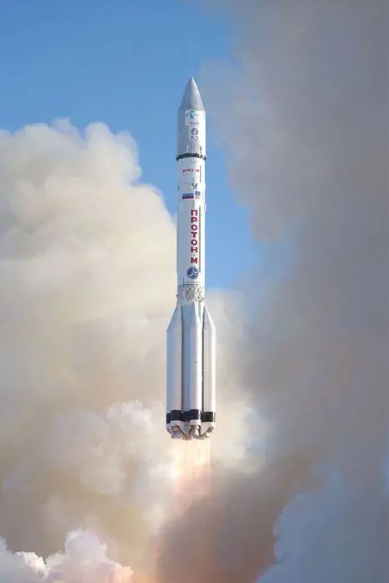
Now let’s turn to the Soviet space program, and consider the Proton roc ket configured with a Blok-D upper stage with a fission thermal engine. We’ll call it Blok-N. The direct Soviet counterpart to the NERVA flight engine was the RD-0410. Thrust=35.3 kN. Dry mass=2,000 kg Specific impulse= 910 s. This engine is lighter than the American 75K NERVA and even more efficient, though it has much lower thrust. The Proton/Blok-N configuration was used in a series of launches to construct a space station called Zarya (“Dawn”) at the Earth-Moon L-4 Lagrange point. After reaching L-4, the Blok-N upper stage would circle behind the Earth through L3 and reach L-5, where it would be safely parked to be reutilized at a future date as an orbital tug. No manned missions would utilize the Blok-N stage due to radiation hazards.
Shackleton Crater (89.9°S, 0°) – A deep, permanently shadowed cold trap. The rim receives near-constant sunlight (over 90% of the lunar day), making it an ideal spot for a solar-powered base.
Cabeus Crater (84.9°S, 35.5°W) – The impact site of NASA’s LCROSS mission, which provided direct, conclusive proof of water ice on the Moon.
Haworth Crater (87.5°S, 6.5°W) – This crater contains some of the coldest measured locations on the Moon.
Faustini Crater (87.3°S, 77.0°E) – Its relatively flat floor makes it a safer candidate for landing and surface operations.
Malapert Massif (86°S, 2.5°E) A large mountain near the South Pole that is illuminated by the sun up to 98% of the time.
Erlanger Crater (86.8°N, 27.9°E) – This crater is a key example of a permanently shadowed region in the north.
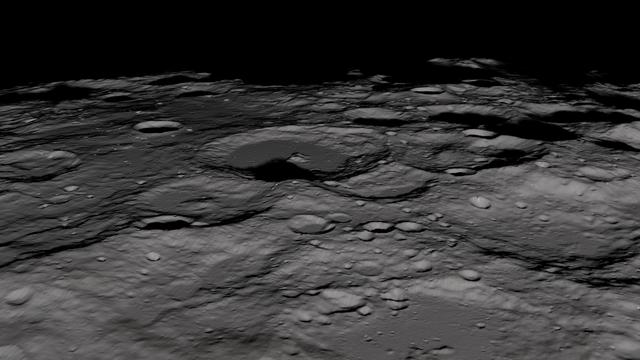
Rozhdestvenskiy Crater (84.9°N, 156.1°W)
India’s Chandrayaan-1 found more than 40 small craters 1 to 9 miles in diameter near the North Pole that contain deposits of relatively pure water ice.
In my alternate timeline the USSR had an agreement with South Yemen to build a spaceport closer to the equator. Transportation hinged on a primary sea route for the large, heavy stages (like the Proton first stage or Blok-D tugs) and a supplementary air route for smaller, more sensitive, or time-critical components (like the Soyuz spacecraft or guidance systems). Rail transport was used exclusively within the USSR to get the components to the port of departure. The journey began at the Khrunichev State Research and Production Space Center in Moscow. The stages of the Proton were rolled to Novorossiysk on the Black Sea, then sailed through the Bosphorus Strait, controlled by Turkey. The freight sailed through the Med and passed through the Suez Canal in Egypt, the Red Sea, and the Arabian Sea to reach Aden in South Yemen. A new, dedicated, high-security port facility was built in South Yemen, complete with heavy cranes and specialized roads for the final leg of the journey to the launch complex at Qawah.
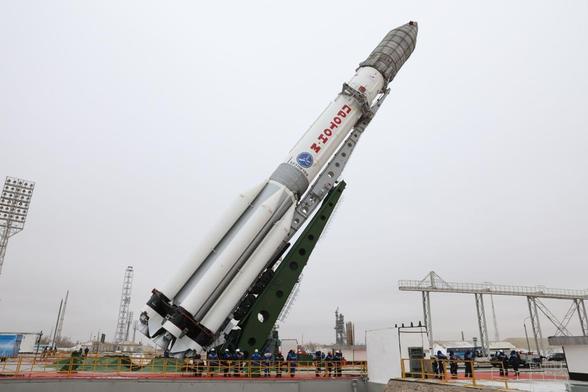
The Soviet Union developed the Blok-N1 upper stage for launch on the Proton rocket. Propellant: 15,000 kg LH2. Engine: 1 x RD-0410 fission thermal motor. Thrust (Vacuum)=35,200 N. Isp =910 s. Burn time=3,600 s. The mission of the Blok-N1 is to haul space station modules to the Zarya (“Dawn”) space station at Earth-Moon L4. The empty tug then continues around the Earth through the L3 point and arrives at a long-term disposal point at L-5 for future use. A 17,360 kg Blok-N1 tug was fitted with landing legs for landing at Rozhdestvenskiy Crater (84.9°N, 156.1°W). The Erwin base exists at the north pole of the moon where lunar ice is extracted and solar power is used to crack it into hydrogen. This allows the USSR to supply Zarya or Midway with LH2 without the necessity of a Proton launch to LEO. Blok-N1 dry mass + legs + fuel transfer gear = 3,350 kg. Total Midway round-trip delta-V = 5,400 m/s. This requires 1,850 kg of LH2. Payload delivered to Midway = 13,010 kg. Payload delivered to Zarya =13,300 kg.

 Terminal Cruise