Y

Y0

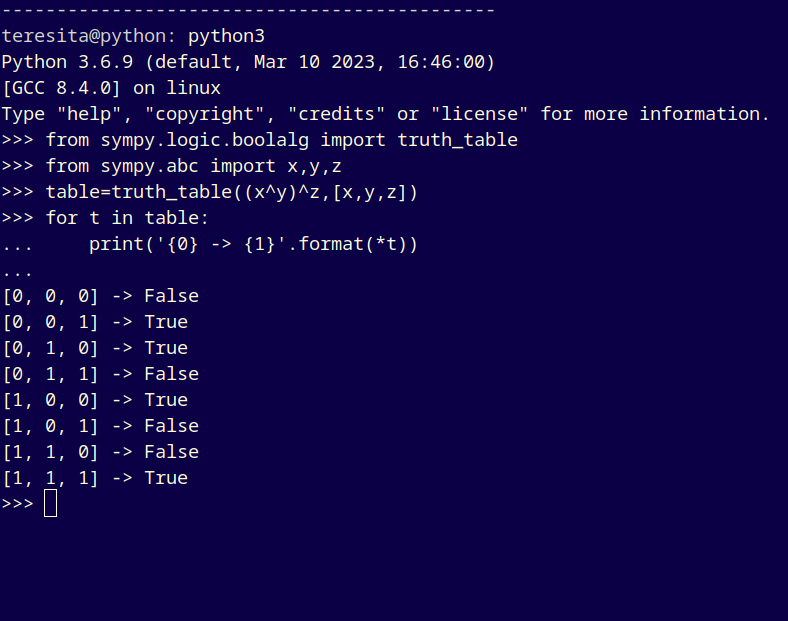
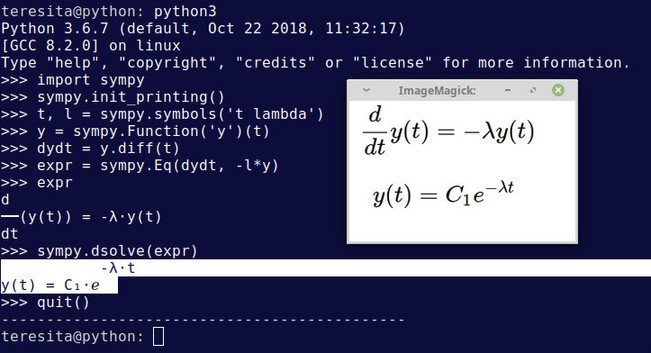
Truth tables in Python

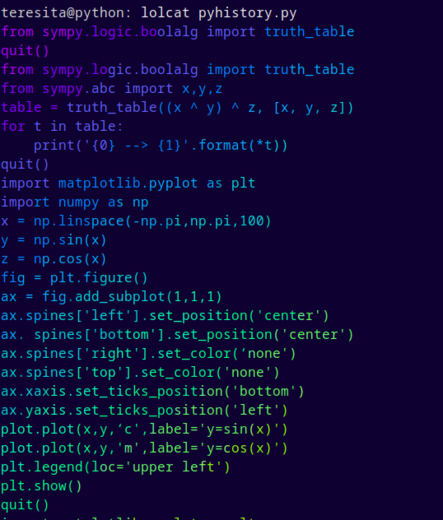
from sympy.logic.boolalg import truth_table
from sympy.abc import x, y, z

table = truth_table((x ^ y) ^ z, [x, y, z])
for t in table:
    print('{0} -> {1}'.format(*t))


Y1

Use awk to make your Mastodon follow list into an RSS feed
awk -F'[@,]' '{print "https://" $2 "/@" $1 ".rss"}' following_accounts.csv


Y2

Ares: “Xena, what’s your sign?”
Xena: “Do not Enter”

Ares: “Hey, come on, we’re both here at this bar for the same reason.”
Xena: “Yeah! Let’s pick up some chicks!”

Ares: “I know how to please a woman.”
Xena: “Then please leave me alone.”

Ares: “I want to give myself to you.”
Xena: “Sorry, I don’t accept cheap gifts.”

Ares: “I can tell that you want me.”
Xena: “Ohhhh. You’re so right. I want you to leave.”

Ares: “If I could see you naked, I’d die happy.”
Xena: “Yeah, but if I saw you naked, I’d probably die laughing.”

Ares: “Your body is like a temple.”
Xena: “Sorry, there are no services today.”

Ares: “I would go to the end of the world for you.”
Xena: “Yes, but would you stay there?”

Ares: “Your place or mine?”
Xena: “Both. You go to yours and I’ll go to mine.”

Ares: “How do you like your eggs in the morning?”
Xena: “Unfertilized!”


Y3


Y4


Y5


Y6


Y7

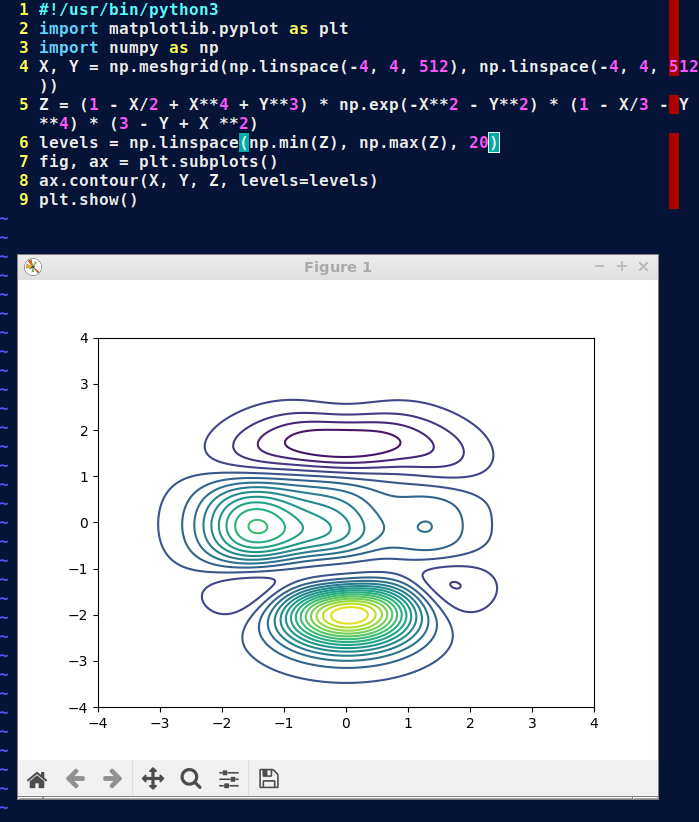
Generating contour maps with Python

#!/usr/bin/python3
import matplotlib.pyplot as plt
import numpy as np

# Grid
X, Y = np.meshgrid(np.linspace(-4, 4, 512), np.linspace(-4, 4, 512))

# Base function with slight asymmetry
Z = (1 – X/2 + X**4 + Y**3) * np.exp(-X**2 – Y**2) * (1 – X/3 – Y**4) * (3 – Y + X**2)

# Lower-frequency smooth perturbation
Z += 0.5*np.sin(0.8*X + 0.6*Y) + 0.4*np.cos(0.5*X – 0.7*Y) + 0.3*np.sin(0.6*X – 0.4*Y)

# Contour levels
levels = np.linspace(np.min(Z), np.max(Z), 25)

# Plot
fig, ax = plt.subplots()
ax.contour(X, Y, Z, levels=levels, cmap=’terrain’)
plt.show()


Y8


Y9

Building a square wave with a Fourier series of odd harmonics under Python

#!/usr/bin/python3
import numpy as np
import matplotlib.pyplot as plt
x = np.linspace(0, 2*np.pi, 1000)
def square_wave_series(x, n_terms):
    y = np.zeros_like(x)
    for k in range(1, n_terms+1):
        n = 2*k - 1   # odd numbers: 1,3,5,...
        y += np.sin(n*x)/n
    return (4/np.pi) * y
colors = ["blue", "green", "yellow", "orange", "red"]
for i, n in enumerate([1, 2, 3, 4, 5]):
    y = square_wave_series(x, n)
    plt.plot(x, y, color=colors[i], label=f"{2*n-1} harmonics")
plt.legend()
plt.title("Fourier Series Approximation of a Square Wave")
plt.grid(True)
plt.show()


YA

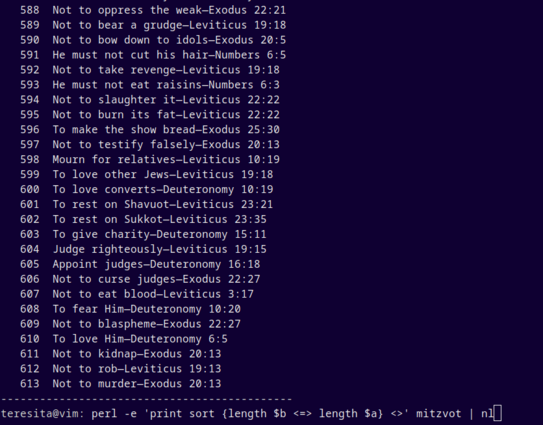
Print all the four letter words in the Bible:

perl -ne 'for(/\w+/g){$w=lc; $seen{$w}=1 if length$w==4} END{print"$_ " for sort keys %seen}' kjv.txt


YB

Abundant, perfect, and deficient numbers with Python

#!/usr/bin/python3
import sys; beg,end=int(sys.argv[1]),int(sys.argv[2]);[print(f"{n} is "+("perfect" if (s:=sum(x for x in range(1,1+n//2) if n%x==0))==n else "abundant" if s>n else "deficient")) for n in range(beg,end+1)]


6y


YD

Display the contents of a large directory without line breaks:

printf "%s / " *; echo


YE

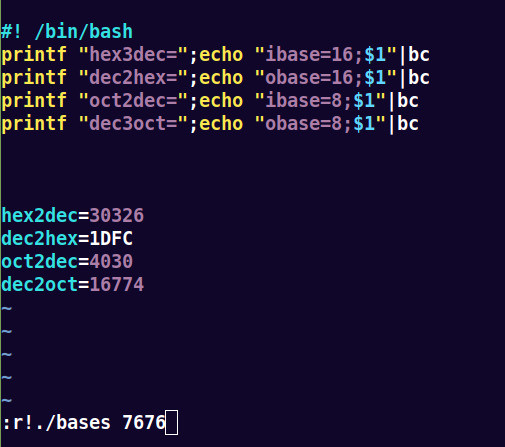
Convert between numerical bases with impunity:

#!/bin/bash
num=$1
from=$2
to=$3
dec=$(echo "ibase=$from; $num" | bc)
conv=$(echo "obase=$to; $dec" | bc)
echo "$conv"


YF

Use Python to find the positive local minimum of the gamma function:

#!/usr/bin/env python3
import numpy as np
from scipy.special import gamma
from scipy.optimize import minimize_scalar

# Interval near origin for first local minimum
a, b = 0.1, 2.0
n_iter = 25  # number of iterations to display

# Golden-section search manually to control iteration printing
phi = (1 + 5**0.5) / 2
invphi = phi - 1  # 1/phi

# Initial points
c = b - invphi * (b - a)
d = a + invphi * (b - a)
fc, fd = gamma(c), gamma(d)

print(f"{'Iter':>4} {'x':>12} {'gamma(x)':>12}")
for i in range(1, n_iter + 1):
    if fc < fd:
        b, d, fd = d, c, fc
        c = b - invphi * (b - a)
        fc = gamma(c)
        x_min = c
        f_min = fc
    else:
        a, c, fc = c, d, fd
        d = a + invphi * (b - a)
        fd = gamma(d)
        x_min = d
        f_min = fd
    print(f"{i:4d} {x_min:12.8f} {f_min:12.8f}")

print(f"\nLocal minimum approx: x = {x_min:.10f}, gamma(x) = {f_min:.10f}")

#!/usr/bin/env python3
import numpy as np
import matplotlib.pyplot as plt
from scipy.special import gamma

# Interval near the origin
x = np.linspace(0.1, 2.0, 500)
y = gamma(x)

# Approximate minimum from your iterations
x_min = 1.461632 # from your 25-iteration run
y_min = gamma(x_min)

plt.figure(figsize=(8,4))
plt.plot(x, y, label="gamma(x)")
plt.axvline(x_min, color='red', linestyle='--', label=f"Min near x={x_min:.6f}")
plt.scatter(x_min, y_min, color='red')
plt.title("Gamma function near its first local minimum")
plt.xlabel("x")
plt.ylabel("gamma(x)")
plt.grid(True)
plt.legend()
plt.tight_layout()
plt.show()


YG

Shell function to calculate the ratio of neighboring Fibonacci numbers (φ) with recursion without exponential blow-up:

fibratio ()
{
echo "define f(n){auto a,b,t,i;a=0;b=1;for(i=2;i<=n;i++){t=a+b;a=b;b=t};if(n==0)return 0;return b};for(i=2;i<=$1;i++) print f(i)/f(i-1),\"\n\"" | bc -l
}


YH

Get a count of each word in the Bible with awk

awk '{for(i=1;i<=NF;i++){w=tolower($i); gsub(/[^a-z]/,"",w); if(w!="") count[w]++}}END{for(w in count) print count[w], w | "sort -nk1"}' kjv2.txt


YI

Print every word in the Bible that follows ‘thou shalt not’ with awk

awk '{n=split(tolower($0),a,"thou shalt not "); if(n>1){split(a[n],b,/[^a-z]+/); print b[1]}}' kjv.txt | sort -u


YJ

The Weierstrass monster with Python

#!/usr/bin/python3
import numpy as np
import matplotlib.pyplot as plt

# Parameters
a = 0.5        # 0 < a < 1 b = 11 # odd integer, large enough that ab > 1+3pi/2
n_terms = 50   # number of terms in the series
x = np.linspace(-2, 2, 20000)

# Compute the Weierstrass function
f = np.zeros_like(x)
for n in range(n_terms):
    f += a**n * np.cos(b**n * np.pi * x)

# Plot
plt.figure(figsize=(10,4))
plt.plot(x, f, color='blue', linewidth=0.5)
plt.title("Weierstrass Function (Continuous Everywhere, Differentiable Nowhere)")
plt.xlabel("x")
plt.ylabel("f(x)")
plt.grid(True)
plt.show()


YK

Build a list of unique words from a text file

tr -cs '[:alpha:]' '\n' < gettysburg.txt | tr '[:upper:]' '[:lower:]' | sort -u


YL

Calculate parallel resistance (or series capacitance) for any number of discrete components with Python

python3 -c "import sys; print(f'{1/sum(1/float(x) for x in sys.argv[1:]):.2f}')" 1800 2700 3300


YN


YO

I AM LEIA OF BORG. I’d rather assimilate a Wookie!

WE ARE PINK FLOYD OF BORG: We don’t need no assimilation. All in all, we’re just Borgs in the wall.

I AM ANDY ROONEY OF BORG: Ever wonder why resistance is futile?

I AM 007 OF BORG: You will be shaken, not assimilated.

I AM COOL HAND OF BORG: What we have here is a failure to assimilate!

I AM POPE LEO OF BORG: Resistance is irreverent!

I AM ROCKNE OF BORG: Go out there and assimilate one for the Gipper!

I AM C-3PO OF BORG: I am fluent in over 6 million forms of assimilation.

I AM VADER OF BORG: You will be assimilated. The Collective has foreseen it. Resistance is futile. It is your destiny.

I AM FRANK SINATRA OF BORG: Your way is irrelevant. You will be assimilated my way.

I AM DAFFY DUCK OF BORG: You – You – Yooourrrr’e Irrelevant!

I AM MR. T OF BORG: I pity da fool that resists me! You gonna be assimilated, sucka!

I AM MR. ROGERS OF BORG: It’s a beautiful day in the Collective. Can you say assimilate, boys and girls?


YQ


YR